
Yakult Group's Approach to Sustainability
The Yakult Group Basic Policy on CSR was established based on our corporate philosophy as well as our belief that “in order for people to be healthy, everything around them must also be healthy.” We will also contribute to the achievement of a sustainable society through initiatives based on our material themes.
Basic Policy on CSR
We at the Yakult Group will implement corporate social responsibility (CSR) activities by generating tangible benefits in accordance with our corporate philosophy and realizing sustainable corporate growth. Specific CSR activities in accordance with this objective are articulated in our Basic Policy on CSR, which was established in April 2012.
By systemizing the CSR initiatives undertaken at Yakult Group units, we increase the clarity of Yakult’s CSR management policies and undertake appropriate disclosure of information to stakeholders.
Basic Policy on CSR
All of us in the Yakult Group will strive through corporate activities based on our corporate philosophy to earn the trust of all the Group’s stakeholders and promote mutually beneficial relationships with all stakeholders.
Yakult Ethical Principles and Code of Conduct
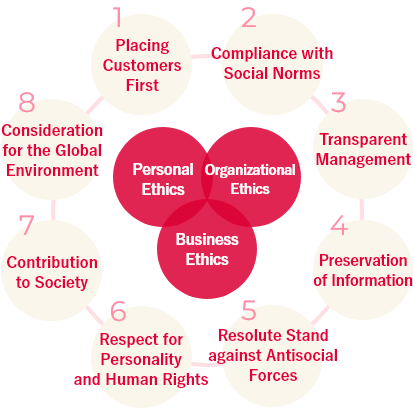
The Yakult Ethical Principles and Code of Conduct serve as standards of compliance for correctly implementing Yakult’s founding spirit, Shirota-ism. They set forth the principles and behavioral guidelines for proper corporate activities within the Yakult Group, providing specific guidance and illustrative examples.
Revisions are made as needed, such as by appending specific conduct standards and concrete examples of such standards, in response to changing times.
In addition, a pocketbook including the Yakult Ethical Principles and Code of Conduct has been distributed to employees so that they can easily refer to them at any time when they need to confirm a particular decision-making process.
Yakult EthicalPrinciples & Code of Conduct
Sustainability governance
In fiscal 2024, we established a Sustainability Advisory Committee as an advisory body to the Board of Directors.
Topics presented to the Sustainability Advisory Committee for discussion are thoroughly debated by the Sustainability Promotion Committee, which is chaired by the member of the Yakult Honsha Board of Directors in charge of sustainability promotion and made up of executive officers from relevant departments. Deliberated topics are presented to the Management Policy Council and the Executive Officers Committee as necessary.
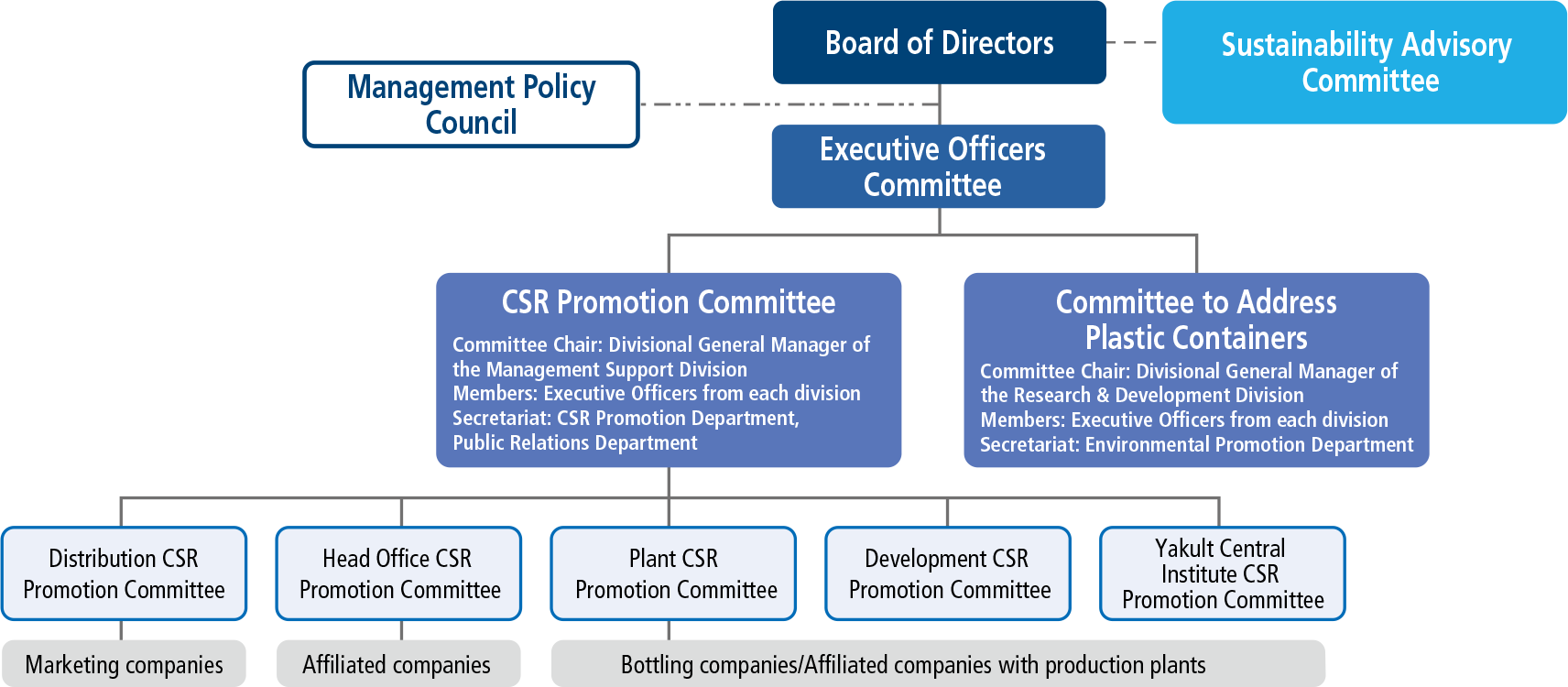
Sustainability Advisory Committee
The Sustainability Advisory Committee deliberates on basic sustainability strategy, measures and responses in the context of our efforts to resolve environmental and social problems, and reports its findings to the Board of Directors.
The committee has eight members, including three independent Outside Directors and one Audit & Supervisory Board Member.
Through this committee, we aim not only to strengthen the Board of Directors’ oversight of our sustainability initiatives and live up to our social responsibilities as a corporation but also to facilitate sustainable development of the environment, society and our corporation.
Sustainability Advisory Committee agenda items
| Event | Agenda items |
|---|---|
| May 15 (1st mtg.) |
|
| July 2 (2nd mtg.) |
|
| July 31 (3rd mtg.) |
|
| Sept. 27 (4th mtg.) |
|
| Feb. 28 (5th mtg.) |
|
Sustainability Promotion Committee
In fiscal 2025 we merged the CSR Promotion Committee and the Committee to Address Plastic Containers to form the new Sustainability Promotion Committee. This centralizes CSR and plastic container-related initiatives in a single committee that will discuss and promote basic strategy and measures.
The Sustainability Promotion Committee, which is chaired by the member of the Yakult Honsha Board of Directors in charge of sustainability promotion, holds meetings four times per year to discuss and manage progress on policies and promotional measures around various sustainability-related management issues, including climate change. In fiscal 2024, the committee discussed the identification of salient human rights issues, important for promoting human rights due diligence, and what to disclose based on the recommendations of the Task Force on Climate-related Financial Disclosures (TCFD). It also considered the progress and results of the Sustainability Action Plan and deliberated on updates to Environmental Targets 2030, medium-term milestones toward the Yakult Group Environmental Vision.
The head of the Sustainability Promotion Committee, a director and senior managing executive officer, also approves the items covered in our Sustainability Report.
We have also established six specialized committees as subordinate organizations to carry out specific activities within each department as a way to promote sustainability initiatives throughout the Group.
CSR Promotion Committee agenda items
| Event | Agenda item |
|---|---|
| June 4 (1st mtg.) |
|
| Aug. 28 (2nd mtg.) |
|
| Nov. 5 (3rd mtg.) |
|
| Feb. 12 (4th mtg.) |
|
- ※1 Corporate Sustainability Reporting Directive (CSRD): An EU directive to corporations on the disclosure of sustainability information
- ※2 Science Based Targets (SBT): Corporate greenhouse gas emissions reduction targets that meet the standards called for by the Paris Agreement
Signing the UN Global Compact
In May 2021, the Yakult Group signed the United Nations Global Compact (UNGC), the UN’s international framework for sustainable growth.
The UNGC calls on companies and organizations to take part in solving global issues and provides a principle-based framework for healthy globalization and a sustainable society.
The Yakult Group’s top management is committed to supporting the 10 principles of the UNGC relating to human rights, labor, the environment and anti-corruption, and we will work with the global community to apply these principles in all of our business activities as a good corporate citizen that contributes to society.
The 10 Principles of the UN Global Compact (UNGC10)
| Human Rights | Principle 1: Businesses should support and respect the protection of internationally proclaimed human rights; and |
|---|---|
| Principle 2: make sure that they are not complicit in human rights abuses. | |
| Labour | Principle 3: Businesses should uphold the freedom of association and the effective recognition of the right to collective bargaining; |
| Principle 4: the elimination of all forms of forced and compulsory labour; | |
| Principle 5: the effective abolition of child labour; and | |
| Principle 6: the elimination of discrimination in respect of employment and occupation. | |
| Environment | Principle 7: Businesses should support a precautionary approach to environmental challenges; |
| Principle 8: undertake initiatives to promote greater environmental responsibility; and | |
| Principle 9: encourage the development and diffusion of environmentally friendly technologies. | |
| Anti- Corruption |
Principle 10:Businesses should work against corruption in all its forms, including extortion and bribery |
Cross-Reference Table
- Home
- /
- Sustainability
- /
- Yakult Group's Approach to Sustainability
