
 Climate change mitigation and adaptation
Materiality
Climate change mitigation and adaptation
Materiality
Related SDGs

Climate change mitigation and adaptation
Materiality
Related SDGs
Our approach
The Yakult Group recognizes that significant greenhouse gas (GHG) emissions are generated across its entire value chain. To address this, we are advancing GHG emissions reduction efforts in our own operations by further promoting energy conservation and proactively utilizing renewable energy. We are also collaborating with business partners and local communities to reduce emissions throughout the value chain.
Specific initiatives
- Engaging in energy conservation activities
- Proactively introducing renewable energy etc.
Yakult Group Environmental Vision
The world is experiencing climate change and various other environmental issues that are growing more severe with time. The Yakult Group creates products that are available in 40 countries and regions around the world, and we conduct our business on the basis of local production for local sales. We recognize that our corporate activities have not only positive but also negative impacts on local communities and environments in various locations globally.
In March 2021, the Yakult Group created the Yakult Group Environmental Vision to reduce our negative impacts and promote efforts with a positive impact on the global environment with the aim of uniting people and planet as one. We set out our ideal vision for the future in Environmental Vision 2050 and, using backcasting, established milestones in order to effectively act and make progress toward this vision.
Examples of Initiatives
Information disclosure based on TCFD recommendations
In August 2022, we announced our support for the TCFD recommendations.*1 We performed analyses based on multiple climate scenarios*2 for the Yakult Group’s corporate activities, with reference to scenarios provided by the Intergovernmental Panel on Climate Change (IPCC) and International Energy Agency (IEA), and are considering responses to climate-related risks and opportunities while promoting specific initiatives to prepare for the future.
- ※1 TCFD recommendations: Recommendations issued in 2017 by the Task Force on Climate-related Financial Disclosures (TCFD), an international organization established by the Financial Stability Board in 2015. In its final report, the TCFD issued recommendations that companies disclose information on climate-related risks and opportunities through scenario analysis to examine strategies in response to risks and opportunities under various different conditions.
- *2 1.5°C scenario
IPCC SSP1-1.9 scenario: Scenario in which emissions are most reduced, in accord with the Paris Agreement’s 1.5°C objective
IEA Net Zero Emissions by 2050 Scenario (NZE Scenario): Scenario in which net zero is achieved by 2050
4°C scenario
IPCC SSP5-8.5 scenario: Scenario in which emissions are least reduced, with economic growth prioritized, ongoing dependence on fossil fuels, and an expected temperature rise of 4°C
IEA Stated Policies Scenario (STEPS): Scenario based on climate change-related pledges from individual countries, including nationally determined contributions (NDCs) and long-term net zero objectives
Reducing CO2 emissions from our manufacturing and marketing departments
To reduce CO2 emissions at Yakult Honsha plants and bottling companies, we installed LED lighting and determined efficient ways to use production equipment to reduce operating times and energy consumption.
We are also introducing electric vehicles to reduce CO2 emissions of delivery vehicles used by Yakult Ladies at marketing companies.

Solar panels at Okayama Wake Plant

Electric vehicle
Switch to CO2 -free electric power for all group production plants in Japan
Additionally, regarding the Yakult Fuji Oyama Plant, which commenced operations in January 2024, we switched to electricity derived entirely from renewable energy sources provided by power companies with which we have contracts. We also increased the energy capacity of the solar power generation equipment at the Yakult Okayama Wake Plant from 310 kWh to 1,018 kilowatts, an increase of 708 kilowatts that brings the plant’s solar power generation equipment into the megawatt class.
As a result, CO2 emissions at Yakult Honsha plants and bottling companies have decreased by 65.7% compared to fiscal 2018 levels.
- * Scope of calculations: Yakult Honsha Co., Ltd. (including Fukushima Plant, Ibaraki Plant, Fuji Susono Plant, Fuji Susono Pharmaceutical Plant, Hyogo Miki Plant, Saga Plant, Shonan Cosmetics Plant and designated shippers), bottling companies (Yakult Iwate Plant Co., Ltd., Yakult Chiba Plant Co., Ltd., Yakult Fuji Oyama Plant Co., Ltd., Yakult Aichi Plant Co., Ltd., Yakult Okayama Wake Plant Co., Ltd. and Yakult Fukuoka Plant Co., Ltd.).
- Note: As of March 31, 2025
Special
Report
Report from the Frontlines
Caring for the environment and protecting employee health by introducing electric trucks: Guangzhou Yakult Co., Ltd.

Caring for the environment and protecting employee health by introducing electric trucks: Guangzhou Yakult Co., Ltd.
Since 2018, Guangzhou Yakult Co., Ltd. has been pushing forward with the introduction of electric trucks amid China’s increasingly strict vehicle emissions regulations to reduce CO2 emissions and combat air pollution. In this article, a manager discusses these efforts, focusing on the various challenges encountered along the way.
Guangzhou: A city leading the fight against air pollution in China
Guangzhou is the capital of Guangdong province and China’s third largest city after Beijing and Shanghai. Numerous Japanese companies have expanded into this region of flourishing trade. While serious air pollution is often reported in China, Guangzhou has actively worked to address environmental concerns, resulting in a 58.5% reduction in PM2.5 particles and a 44.2% reduction in NO2 emissions (achieving targets for three consecutive years) compared to fiscal 2013 levels. By consistently producing these outstanding figures, Guangzhou has distinguished itself among China’s major cities.
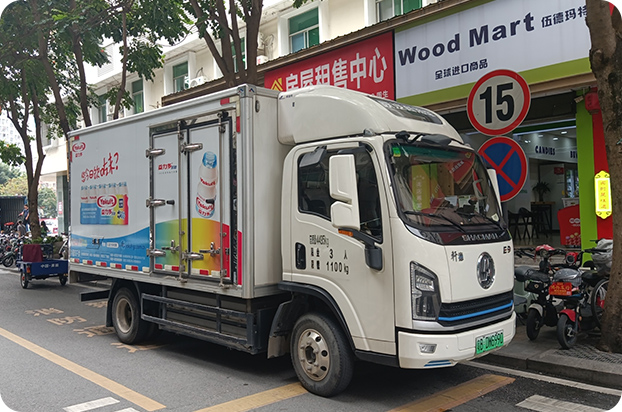
An electric truck on a Guangzhou street
| Air pollutants | Guangzhou (2022) |
Class1 AQI | Class2 AQI | Documented supplementary explanations |
|---|---|---|---|---|
| PM2.5 | 22㎍/㎥ | 15㎍/㎥ | 35㎍/㎥ | Meets standards every day and maintains excellent results among the nation’s major cities, with a 58.5% reduction compared to 2013 levels |
| PM10 | 39㎍/㎥ | 40㎍/㎥ | 70㎍/㎥ | Annual reductions, with a 45.8% reduction compared to 2013 levels |
| Nitrogen dioxide | 29㎍/㎥ | 40㎍/㎥ | 40㎍/㎥ | Targets achieved for three consecutive years, with a 44.2% reduction compared to 2013 levels |
| Ground-level ozone | 179㎍/㎥ | 100㎍/㎥ | 160㎍/㎥ | Annual fluctuations, with a 14.7% increase compared to 2013 levels |
| Sulfur dioxide | 6㎍/㎥ | 20㎍/㎥ | 60㎍/㎥ | Maintains comparatively low levels annually while trending towards reduction, with a 70% reduction compared to 2013 levels |
| Carbon monoxide | 1.0㎍/㎥ | 4.0㎍/㎥ | 4.0㎍/㎥ | Maintains comparatively low levels annually, with a 33% reduction compared to 2013 levels |
Reducing emissions by introducing electric trucks
China has set goals of reducing CO2 emissions per unit of GDP by 65% compared to 2005 levels by 2030, and achieving carbon neutrality by 2060. In order to achieve these goals, regulations on automobile emissions are becoming stricter. In particular, diesel trucks have seen heavy regulation, with their use being restricted within some cities. For Yakult, delivering safe and secure products in a fresh state from our production sites directly to our customers and stores is a common pillar of our business operations throughout the world. In a hot and humid city like Guangzhou, which is located in the subtropics, refrigerated trucks are an indispensable tool. However, around 2018, Guangzhou Yakult Co., Ltd. began feeling the impact of government regulations on emissions, which led to the company’s decision to convert our fleet of diesel trucks into electric ones. Electric trucks cost 30–40% more than diesel ones, but thanks to a subsidy system set up by the Chinese government to encourage electric vehicle use, Guangzhou Yakult Co., Ltd. received an approximate 5% subsidy (as of 2021) to facilitate our introduction of electric trucks.
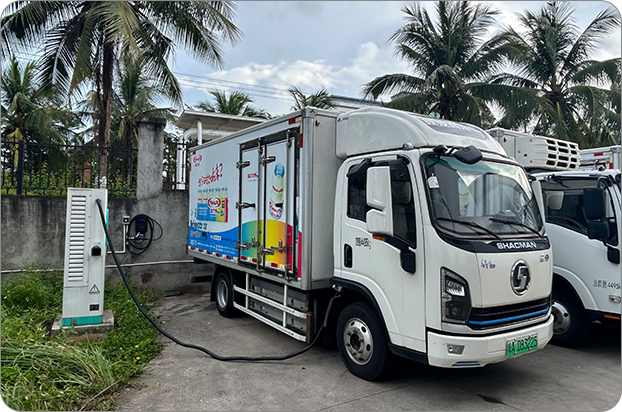
An electric truck at a charging station
Limited model options along with frequent breakdowns and challenges
When we began introducing electric trucks in 2018, there were few models suited to our business needs, so we were forced to lease heavy-duty models. However, few employees possessed the necessary licenses to operate a large vehicle, which made it difficult to set delivery routes and assign tasks. In addition, we frequently experienced breakdowns and other challenges. As we reviewed the way we used our vehicles in our daily operations and communicated with the leasing company about parts that needed improvement, we noticed a gradual reduction in breakdowns, and the leasing company was able to deal with issues more smoothly when they arose. Even so, three years after introducing these electric trucks, we still had no leasing options for models other than large vehicles, and were unable to resolve issues such as driver shortages and high costs. For this reason, in 2021 we shifted our strategy from leasing to directly purchasing electric trucks in order to meet our business needs.
Another major challenge in introducing electric trucks has been installing charging stations. At Guangzhou Yakult Co., Ltd., we have fast charging stations capable of charging vehicles up to 60 kW class, but it takes five to six hours to fully charge two vehicles at once. The charging station is designed to automatically stop when the vehicle is fully charged, but just in case something goes wrong, we make sure that charging only happens during hours when employees are present. In practice, even a fully charged vehicle has a maximum operating range of approximately 150 km. This suffices for deliveries within the city, but is a cause for concern when delivering to suburban areas.
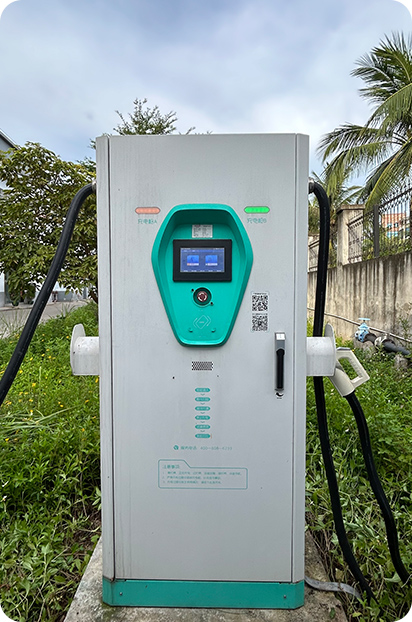
Charging station
Electric vehicle use is expanding thanks to government support, making it possible to purchase vehicle models that suit our business needs
Back in 2018, there seemed to be few companies using electric trucks, but the government’s environmental initiatives over the past five years has rapidly popularized their use. Nowadays Guangzhou residents seem to naturally accept the sight of electric trucks moving throughout the streets.
An electric truck is relatively expensive compared to a gasoline or diesel vehicle, and the issue of limited charging station availability remains unresolved. On the other hand, the price of gasoline, including diesel fuel, has risen steeply, so that electric trucks now offer operating cost benefits that are equal to or even greater than those of diesel trucks. Drivers also appreciate their smooth acceleration.
Still, the greatest effect of introducing electric trucks has been the reduction of our environmental impact. If electric vehicles become more widely adopted throughout Guangzhou, air quality would be improved, helping to protect people’s health. For this reason, Guangzhou Yakult Co., Ltd. will continue to take the lead and promote the use of these vehicles.
Employee Comment

Company: Guangzhou Yakult Co., Ltd.
Department: Promotion Section of Business Planning Department
Name: Lu Manli
**Affiliation and title are as of the time of the interview.
Employee Comment
I’m concerned that global climate change due to the increase in CO2 emissions will have a series of impacts on natural ecosystems, leading to issues in our daily living environment, economy and even society. Personally, I believe that taking steps to protect the environment through efforts such as electricity and water conservation can help improve air pollution and slow the deterioration of the ecosystem.
- Home
- /
- Sustainability
- /
- Environmental
- /
- Climate change mitigation and adaptation
