
Human rights
Yakult Group Human Rights Policy
Yakult Group Human Rights Policy
The Yakult Group operates its global business under the corporate philosophy of “We contribute to the health and happiness of people around the world through pursuit of excellence in life science in general and our research and experience in microorganisms in particular.” In order to fully realize this philosophy it is vital that we create a society where human rights are protected and respected throughout the world.
The Yakult Group recognizes that, in the course of conducting business or through our value chain, there exists the possibility that the group may have a negative impact on human rights, either directly or indirectly, and in order to ensure that the human rights of all people involved in its business are respected, the group shall hereby establish the Yakult Group Human Rights Policy (hereinafter referred to as the “Policy”), shall promote initiatives to further the respect of human rights, shall undertake continuous improvements, and shall contribute to the realization of a sustainable society.
The Yakult Group acts in accordance with the United Nations’ “Guiding Principles on Business and Human Rights” for respecting human rights and supports and respects the following international principles in the execution of its business activities:
- The International Bill of Human Rights (The Universal Declaration of Human Rights, the International Covenant on Civil and Political Rights, and the International Covenant on Economic, Social and Cultural Rights)
- The Tripartite Declaration of Principles concerning Multinational Enterprises and Social Policy (MNE Declaration) and the ILO Declaration on Fundamental Principles and Rights at Work by International Labour Organization (ILO)
- The OECD Guidelines for Multinational Enterprises on Responsible Business Conduct, developed by the Organisation for Economic Co-operation and Development (OECD)
- The Children’s Rights and Business Principles (developed jointly by UNICEF, the UN Global Compact, and Save the Children)
- The Ten Principles of the UN Global Compact
The Yakult Group operates globally and conducts business activities based on the laws and regulations of the countries and regions it operates in. If the laws of a given country or region differ from international human rights norms, the group follows the higher standards. If the laws of the country or region contradict international norms, the group will pursue an internationally recognized method which respects human rights to the maximum possible extent.
1Scope
The Policy applies to all executives and all workers of the Yakult Group. The group also requires all business partners involved with the group’s products and services to be aware of and comply with the Policy.
2Responsibility for respecting human rights
The Yakult Group recognizes that, in the course of conducting business or through our value chain, there exists the possibility that the group may have a negative impact on human rights, either directly or indirectly, and shall strive to prevent any violation of human rights. Further, if there is a negative impact on human rights through its business activities, the group shall appropriately rectify this in accordance with international standards and fulfill its responsibility for respecting human rights in its value chains.
3Establishment of promotion structure
The Board of Directors of Yakult Honsha Co., Ltd. is the party responsible for overseeing the Policy and ensuring adherence to it. The implementation status of initiatives based on the Policy shall be deliberated and discussed by the Sustainability Promotion Committee (which includes directors among its members) and other bodies. All matters of import are to be reported to the Sustainability Advisory Committee and the Board of Directors.
4Human rights due diligence
The Yakult Group shall develop and implement mechanisms for human rights due diligence in order to fulfill its responsibility to respect human rights. The group identifies potential negative impacts of its business activities on human rights and strives to prevent and mitigate these.
5Remediation
If the Yakult Group causes a negative impact on human rights or contributes to a situation which causes a negative impact, the group shall work to correct this and provide remedies to those affected through appropriate means based on international standards.
6Information disclosure
The Yakult Group shall disclose the progress and outcomes of its human rights-related initiatives based on the Policy on its website in other media.
7Dialogue and consultation with stakeholders
The Yakult Group shall draw on independent external expertise in implementing the Policy. The group shall also engage in dialogue and consultation with stakeholders who are affected by, or may be affected by, a direct or indirect negative impact on human rights.
8Education and training
The Yakult Group shall provide necessary education and capacity building to its executives and workers in order to instill the Policy in all business activities and ensure its effective implementation. The group shall also communicate the Policy appropriately to its business partners as needed.
9Salient human rights issues of the Yakult Group
As outlined in the attached document, the Yakult Group has identified the salient human rights issues related to its business activities through human rights due diligence and will take steps across the entire group to address these.
The Policy has been approved by the Board of Directors of Yakult Honsha Co., Ltd. and signed by the President and Representative Director.
Established: April 27, 2021 Revised: October 27, 2025

(Attachment) Salient Human Rights Issues of the Yakult Group
Salient Human Rights Issues of the Yakult Group
- Discrimination: Group workers
The Yakult Group does not place any individual in a subordinate or disadvantaged position in matters such as hiring, promotion, compensation, or work assignments on the basis of the following factors: race, gender, nationality, ethnicity, language, age, religion, faith, social origin, property, sexual orientation, gender identity, health status, and disability.
- Inhumane treatment (From violence, abuse to harassment): Group workers
The Yakult Group does not tolerate any form of harassment, violence, bullying, punitive measures, corporal punishment, psychological or physical oppression, or verbal abuse.
- Sound industrial relations: Group workers
The Yakult Group respects the rights of workers to form and join trade unions and other organizations of their own choosing and engage in dialogue and negotiations with employers. The group does not infringe upon or obstruct these rights.
- Working hours: Group workers
The Yakult Group ensures appropriate management of working conditions to prevent excessive work exceeding the prescribed limits, long working hours (including work on holidays), unpaid overtime, and insufficient rest breaks or days off in accordance with applicable local laws and internationally recognized human rights standards.
- Wages: Group workers
The Yakult Group ensures that wages are paid at levels above the minimum wage as a basic principle and manages its practices to prevent issues such as unpaid overtime, payment of overtime at the same rate as regular wages, wage deductions as a form of disciplinary action, or failure to appropriately present the basis for wage calculations and payment details.
- Occupational health and safety: Group workers
The Yakult Group appropriately manages health and safety in the workplace to ensure that workers’ health and safety are not compromised due to the occurrence of occupational accidents or illnesses, physically demanding tasks, inappropriate working environments or hygiene management, or the lack of necessary safety equipment or training and education.
- Human rights issues in the supply chain: Workers of suppliers
In addition to the human rights issues mentioned above, the Yakult Group does not tolerate any human rights violations in its supply chain, including forced labor through intimidation by confinement or violence, restrictions on workers’ freedom of movement, or the employment of children below the minimum working age.
- Living Environment of Local Residents: Local communities
The Yakult Group strives to ensure that the health of local residents is not adversely affected by air and soil pollution, noise, unpleasant odors, or traffic accidents.
- Access to water and sanitation: Local communities
The Yakult Group strives to prevent the overuse of water and contamination from wastewater in the vicinity of its factories and local operations, so as not to affect local water supplies and infringe upon the rights of local residents to maintain their livelihood.
- Privacy rights: Local communities and consumers
The Yakult Group makes every effort to ensure that personal information and privacy-related data are not collected, stored, processed, transferred, or shared without the consent of the individuals concerned, and that such information is not leaked.
- Safe and secure products and services: Consumers
The Yakult Group works diligently to ensure that defects or malfunctions of its products or quality deterioration due to improper management do not cause health risks, injuries, disabilities, or serious accidents to consumers.
- Ethical and responsible marketing: Consumers
In all advertising, promotional activities, and information dissemination on products and services, the Yakult Group makes every effort to ensure that it does not provide misleading information to consumers through fraudulent, deceptive, or discriminatory expressions, which could cause misunderstanding, adversely impact health, or promote discrimination against specific individuals.
Enhancing Group-wide awareness of the Policy
The Yakult Group Human Rights Policy Guidelines have been published to enhance all Group workers’ understanding and awareness of the Yakult Group Human Rights Policy. The Guidelines provide easy-to-understand explanations of the international norms and standards, as well as the technical terms, contained in the Policy.
An understanding of the Policy and international principles regarding human rights will be promoted among workers in order to broaden respect for human rights throughout the Group.
Please note that the content is currently being updated to reflect the revision of the Human Rights Policy in 2025.
Human rights due diligence
Identifying salient human rights issues
In fiscal 2021, the Yakult Group outlined its key human rights issues in line with the Policy as a step toward concrete implementation. These were reviewed in fiscal 2024 to identify salient human rights issues that pose a risk of causing the most severe negative impacts through the Yakult Group’s activities and business relationships and that require prioritized action.
Salient human rights issues of the Yakult Group
| Salient human rights issue | Stakeholders |
|---|---|
| Discrimination | Group workers |
| Inhumane treatment (from violence, abuse to harassment) | Group workers |
| Sound industrial relations*1 | Group workers |
| Working hours | Group workers |
| Wages | Group workers |
| Occupational health and safety | Group workers |
| Human rights issues in the supply chain*2 | Workers of suppliers |
| Living environment of local residents | Local communities |
| Access to water and sanitation | Local communities |
| Privacy rights | Local communities and consumers |
| Safe and secure products and services | Consumers |
| Ethical and responsible marketing | Consumers |
* 1 Refers to a situation where workers are able to form and join trade unions and other organizations of their own choosing, and engage in dialogue and negotiations with employers without interference or obstruction.
* 2 “Human rights issues in the supply chain” includes human rights issues concerning forced labor/human trafficking, child labor, discrimination, inhumane treatment, freedom of association/collective bargaining rights, working hours, wages, and occupational health and safety at farms, plantations, raw material manufacturers, transport companies, etc.
Formulating roadmaps and action plans for human rights due diligence
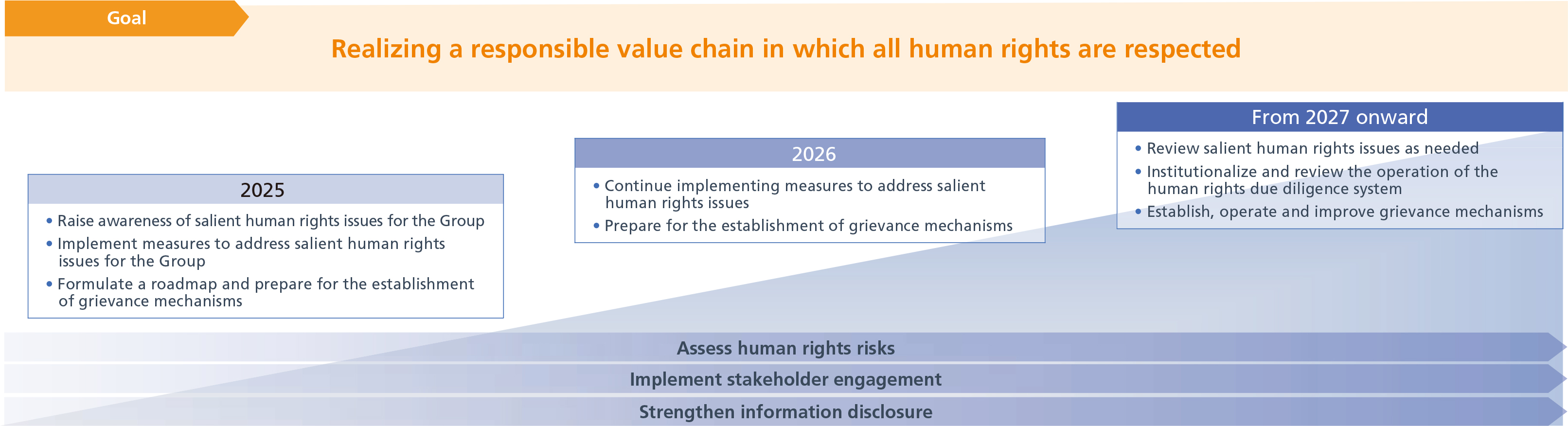
The cross-organizational Human Rights Due Diligence Promotion Council formulates medium- to long-term roadmaps and yearly action plans in its pursuit of promoting concrete measures that enhance respect for human rights. The body is also responsible for implementing the corresponding initiatives, monitoring progress, and formulating plans for the following fiscal year.
Dialogue with stakeholders
In fiscal 2024, we conducted dialogue with experts regarding the Group’s initiatives to respect human rights, including the identification of salient human rights issues. One of the insights shared was the importance of gaining a firsthand sense of human rights issues in the supply chain. In response, we conducted site visits to suppliers and farms from whom we procure raw materials.
We will continue to promote effective human rights initiatives through ongoing dialogue with stakeholders.
- Home
- /
- Sustainability
- /
- Social
- /
- Human rights
